
Managing My Reading List with Feedly & Pocket
Until recently, I used Instapaper to keep track of blog posts (and other text material) that I intend to read later. Instapaper's web interface is organized, its reading view is clean, and the "Read Later" bookmarklet works nicely. Also, there are apps available for both iPhone and iPad, which I mostly use for reading.
I was happy with it — until I took a look at Pocket, which I like even better.

Pocket, My New Favorite Reading Tool #
The thing I like best about Pocket is being able to download not only the text version of an article for later offline use, but also the original HTML view. Some blog posts include source code in a format that isn't always displayed correctly in the text-only view, sometimes not at all.
Another good thing is the Pocket browser extension for Google Chrome. Since I've configured Chrome to delete all browsing data (including cookies) when closing the last tab, I had to log back in to Instapaper every browser session. Not so with Pocket: The extension asks for your credentials once and then stores them — though not in cookies.
There are some other advantages, too:
- I like being able to search through my entire archive. Oftentimes, I remember having read a blog post about a particular topic, which I can then quickly pull out of my archive.
- Pocket synchronizes my reading position for each saved item across devices and platforms. This way, I can simply pick up my iPad and continue reading where I left off on my desktop.
- Finally, Pocket is pretty to look at. Who doesn't enjoy a nice design?
Integrating Pocket with Feedly and More #
So far, I've talked about why I chose Pocket over Instapaper. Let me now give you a quick rundown on how I use it in combination with Feedly and other services.
Currently, I'm subscribed to about 35 RSS feeds. That makes for a lot of content coming my way. After Google Reader died in mid-2013, I imported all my feeds into Feedly, which I've been using ever since. Now, I have configured Feedly to use Pocket as my favorite reading tool. This adds a little icon in the upper right-hand corner, which sends the article to Pocket when clicked:
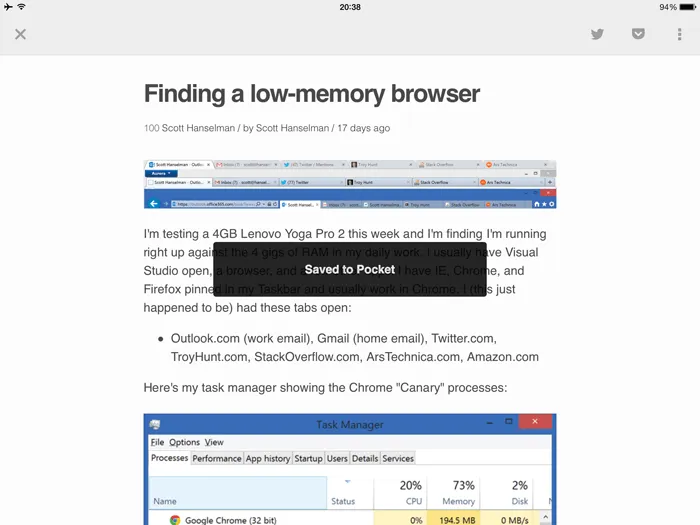
I can now simply skim through all new posts and choose which ones I want to read later. This is the main idea behind managing my reading list: I'm separating the process of choosing what to read from actually reading it.
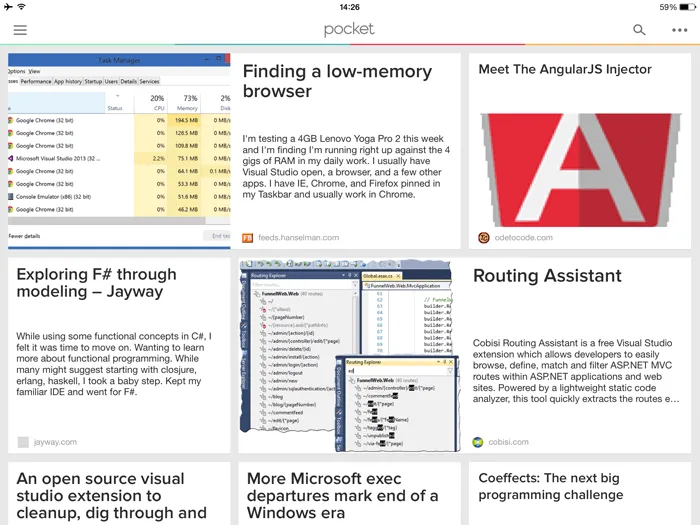
The advantage of this two-step process is that my Pocket reading list only contains content that I've actively put there. RSS feeds are great, don't get me wrong, but they also contain plenty of material that I'm not interested in reading. Remember, it's not what you read, it's what you ignore. When, at some point, I choose to sit down and work through the list, I don't have to wade through uninteresting posts; the good stuff is already there:
This kind of pre-filtering has worked very well for me so far, and it might for you, too!